Capturing Childhood Wonder with a Set of Toys Icon Vectors
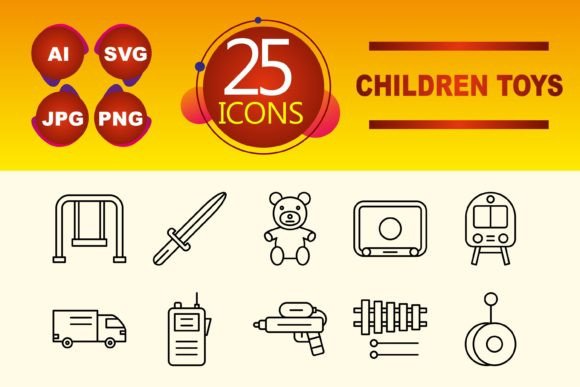
When designing for themes of childhood, play, or education, finding the right visual shorthand is crucial. A collection of icons can communicate complex ideas instantly, saving space and creating a cohesive visual language. This set of Children Toys icons, available as clean Line Icons, offers exactly that utility. These aren't just decorative graphics; they are functional design assets built for clarity and versatility across a wide range of professional projects.
The Simple Charm of Line Icon Styles
The defining characteristic of this Children Toys set is its use of the line icon style. This approach strips away fills, shadows, and complex details to focus on pure outline. The result is a collection that feels light, modern, and incredibly adaptable. Each icon—whether depicting a teddy bear, a rocking horse, a toy car, or a building block—is reduced to its essential form. This minimalism gives the icons a universal appeal; they are neither overly childish nor starkly corporate, sitting in a perfect middle ground that can suit a playful brand or a serious educational app.
Their visual personality is friendly and approachable, yet clean and precise. The lines are typically consistent in weight, creating a uniform family that works seamlessly together. This consistency is key for user interface design templates or website templates where a predictable visual rhythm aids navigation. Overall, the appeal lies in their practicality. They don't shout; they simply and effectively communicate the concept of 'toy' or 'play' in a way that integrates smoothly into your existing design.
Professional Applications Beyond the Playroom
You might initially think of these icons for a children's store app or a kindergarten website, but their utility extends much further. Entrepreneurs and marketers creating presentations for family-oriented products can use these icons to create engaging infographics that break down complex information. Publishers and bloggers writing about parenting, child development, or toy reviews can embed them into articles or social media graphics to add visual interest and improve content scannability.
For content creators and crafters, these vector files become invaluable. The included AI and SVG formats mean the icons are infinitely scalable and editable. You can adjust line weights, change colors, or even combine elements to create unique logos for a small business like a toy repair service or a children's crafting workshop. The PNG and JPG files provide ready-to-use options for quick digital projects, ensuring you have the right file type for every scenario, from a web design mockup to a printed flyer.
Building a Cohesive Visual System
Using a dedicated set like this Children Toys collection does more than just add pictures; it builds a system. In branding and marketing, visual consistency reinforces professionalism and aids brand recognition. If every touchpoint—your mobile app, your website templates, your promotional materials—uses the same style of icon to represent related concepts, your audience begins to recognize and trust that visual language. This set acts as a foundational component of that language for projects centered on childhood themes.
From a user experience perspective, these icons influence readability and hierarchy by serving as clear visual anchors. In a dense interface design template, a simple line icon of a puzzle piece next to a 'Games' section header is faster to parse than text alone. It creates a visual break, guides the eye, and enhances overall engagement by making the environment more intuitive and less text-heavy.
Practical Guidance for Implementing the Icon Set
Before integrating these Children Toys icons into your project, take a moment to evaluate the fit. Does the line style align with your other design elements? If your overall aesthetic uses bold colors and thick shapes, these delicate outlines might need to be adjusted in weight or color to stand out. Testing is essential. Place a few key icons into your actual layouts—a website banner, a slide in a presentation, an app screen—to see how they interact with your existing typography and imagery.
Consider your audience's needs. While the icons are clear, their effectiveness depends on context. In an application for very young children, a line icon of a doll might need to be paired with a label or a more illustrative graphic for absolute clarity. For an adult audience browsing a toy catalog online, the icons serve as perfect, speedy categorizers.
Font pairing, though not directly related to icons, is a parallel consideration. When using these icons, the typeface you choose for accompanying text should complement their style. A clean sans serif font often works well, mirroring the icons' modern and uncluttered feel. Avoid overly decorative script fonts that might clash with the icons' simplicity and reduce overall readability.
Leveraging the File Formats for Maximum Flexibility
The inclusion of multiple file types (AI, SVG, PNG, JPG) is a significant feature. For commercial projects aiming for a strong brand identity, the AI and SVG files are your primary tools. As vectors, they allow you to tailor the icons to your exact brand colors and scale them up for large format printing without quality loss. The PNG files, typically with transparent backgrounds, are ideal for digital use where you need a crisp asset at a fixed size, perfect for social media graphics or web buttons.
Always review the commercial licensing terms provided with the set to ensure your use case is covered, especially for resale products like website templates or app themes you plan to distribute. Using licensed, premium design assets like this protects your work and adds to its professional value.
In practice, this means a designer can use the SVG files to craft a unique logo design for a children's book publisher, a marketer can use the JPGs to quickly assemble an email campaign infographic, and a hobbyist can use the PNGs to create custom labels for a toy storage system. The ten icons provide a focused toolkit, encouraging you to use them sparingly and purposefully to create a recognizable and effective visual theme centered on the universal and joyful concept of Children Toys.