The Essential Role of Icon Design in Digital Communication: A Look at Specialized Collections
In the bustling digital landscape, where information is consumed at lightning speed, visual communication has become paramount. Words alone often struggle to convey complex ideas quickly. This is where icons—those small, symbolic images—step in as universal visual shorthand. They guide us through apps, clarify interfaces, and simplify complex data in presentations. Today, we explore the art and utility of professional icon sets, focusing on how specialized collections, such as a meticulously crafted virus and medical icon set, empower creators across fields.
Beyond Decoration: The Purpose and Significance of Icons
An icon is not merely a decorative graphic. Its primary purpose is functional communication. A well-designed icon instantly communicates an action, concept, or category. Think of the universal power symbol (a circle with a vertical line) or the envelope icon for mail. In medical and scientific contexts, this clarity is even more critical. A set of icons representing viruses, medical tools, health statuses, and biological processes can transform a dense research paper, a public health infographic, or a medical app interface into an accessible and understandable resource.
The significance lies in their ability to bridge language and literacy barriers, providing a common visual language. For designers, developers, educators, and business professionals, having a cohesive set of such icons means being able to communicate with precision and efficiency, ensuring the audience's focus remains on the content's message, not on deciphering unclear visuals.
What Makes a Professional Icon Set "Special"?
When you encounter a "special collection," it signifies a level of craftsmanship and intentionality beyond basic graphics. Let's dissect the key features that define such a collection, turning it from a simple asset into a valuable tool.
Foundational Design Principles: Consistency and Precision
The backbone of any professional icon set is consistency. This is achieved through strict design rules.
- Outlined Stroke Icons: Often called "glyph" style, these icons use clean strokes to define shapes. This approach ensures clarity at various sizes and maintains a modern, neutral aesthetic that doesn't overpower other design elements. It’s particularly effective for technical and scientific subjects where visual noise must be minimized.
- Pixel Perfect Craftsmanship: This term refers to the meticulous alignment of icon edges to the pixel grid. It prevents blurry or anti-aliased edges when displayed on screens, especially at smaller sizes. This attention to detail guarantees that your icons look sharp and professional on every device and resolution.
- Neat Organization: A well-structured set has logically named files and layers within each vector file. For a virus and medical set, icons might be grouped into subcategories like "Pathogens," "Equipment," "Actions," and "Status." This organization saves hours of frustration, allowing you to find and edit the exact icon you need instantly.
The Practical Relevance: Where Do These Icons Fit?
The utility of a specialized icon set extends across modern life and work. Its adaptability is its greatest strength.
- Healthcare Technology & Apps: From patient dashboard symbols to features in telemedicine applications, clear icons for symptoms, medications, and lab results enhance user experience and comprehension.
- Educational Materials & Infographics: Teachers and content creators can use these icons to illustrate biological concepts, explain viral transmission, or create engaging public health guides. Visual aids significantly improve learning retention.
- Business & Scientific Presentations: In corporate or academic settings, presenting complex data is common. Icons can break down intricate processes, highlight key statistics about health trends, or symbolize different research phases, making slides more impactful.
- Print & Digital Publications: Whether in a printed brochure for a clinic or a digital article on a health blog, icons serve as effective visual anchors that draw the reader’s eye and break up text-heavy content.
Clarifying Common Assumptions About Icon Sets
There are a few common misunderstandings worth addressing. First, some assume that icons are only for web designers. As outlined above, their use is multidisciplinary. Second, there's a belief that once you buy an icon set, you’re locked into its default look. This is not true for high-quality vector sets. The colors, strokes, and even shapes can often be modified, allowing you to tailor them to your brand's palette. Lastly, the term "vector" can be confusing for beginners. Simply put, vector graphics (like AI and SVG files) are based on mathematical paths, not pixels. This means they can be scaled to any size—from a tiny app button to a large poster—without any loss of quality, which is essential for true versatility.
Understanding the Value: What You Get in a Business Icon Package
Investing in a professional business icon package is about acquiring a complete, ready-to-deploy toolkit. For a set focusing on virus and medical themes, the practical deliverables typically include:
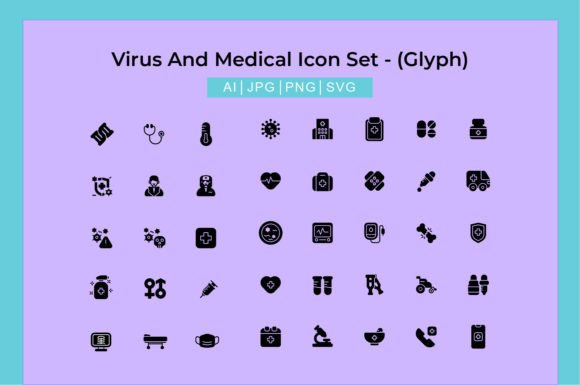
- Quantity & Scope: A package of 40 icons provides a substantial library covering the core visual needs for projects in this niche, ensuring you don’t have to mix and match from disparate sources.
- Standard Size: A base size of 64px is a common, versatile starting point that balances detail with usability for many screen applications.
- Critical File Formats:
- AI (Adobe Illustrator): The native, editable vector source file for advanced design work.
- SVG (Scalable Vector Graphic): A web-friendly vector format perfect for modern websites and applications.
- PNG Transparent: Rasterized images with transparent backgrounds, ideal for quick placement in documents, slides, or basic image editors.
- JPG: A standard format useful for certain print contexts or environments where transparency isn’t required.
This multi-format approach ensures that whether you are a developer coding a website (using SVG), a designer crafting a brochure (using AI), or a educator making a worksheet (using PNG), you have the right file type for your workflow. The promise of easy editing, color changing, and modification is rooted in these vector formats. With basic software, you can adapt the icons to perfectly align with your project’s unique requirements, making them a truly flexible asset.
Building a Broader Understanding: Icons as Part of Visual Literacy
Ultimately, utilizing a specialized icon set is about participating in a broader culture of visual literacy. As society becomes more visually oriented, the ability to use and understand visual symbols becomes a key skill. For creators, choosing a professionally designed set means you are contributing to clearer, more effective communication. You are ensuring that your audience—whether patients, students, clients, or the general public—receives information in the most digestible and engaging way possible.
The decision to integrate such a tool into your projects is not just a design choice; it’s a communication strategy. It speaks to a commitment to quality, clarity, and user-centric thinking. So, when you find a collection that resonates with your needs—one built with outlined strokes, pixel-perfect precision, and organized for efficiency—you are acquiring more than just images. You are gaining a powerful language to tell your story, explain your data, and guide your audience.
In a world overflowing with information, the power to simplify and clarify is invaluable. A dedicated icon set provides that power. It turns complex topics, like virology and healthcare, into accessible visual narratives. It enhances your work's professionalism and impact across print, web, symbols, apps, and infographics. With the ability to easily edit and adapt them, these icons become a foundational part of your creative toolkit, ready to meet the needs of your next project, today and in the future.