The New Crescent: How Family Looking for Hilal Illustration Captures Modern Ramadan Narratives
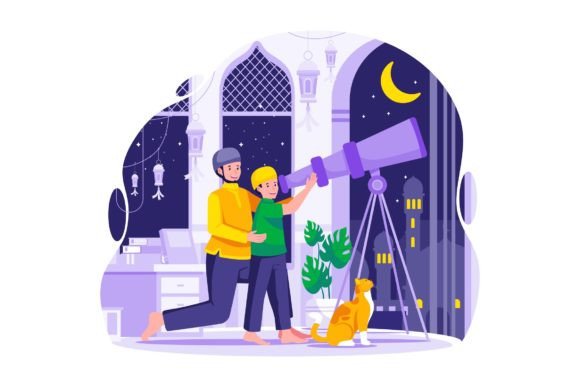
In the digital age, visual storytelling has become paramount for communicating cultural traditions and personal faith. Among the most evocative concepts emerging is the Family Looking for Hilal Illustration. This artwork, depicting a father and son gazing at the sky through a telescope in search of the crescent moon (hilal) that heralds Ramadan, is more than a seasonal graphic. It is a rich, symbolic asset that resonates across professional design, marketing, and personal projects, reflecting a deeper convergence of tradition, technology, and contemporary visual communication.
Understanding the Family Looking for Hilal Illustration Concept
At its core, this illustration visualizes a profound moment: the communal and familial anticipation for the start of the Holy Month of Ramadan. The hilal, or new crescent moon, is the astronomical sign that marks this beginning. The scene of a father and son engaged in this search together encapsulates multiple layers of meaning—it speaks to heritage, education, shared experience, and the blend of ancient ritual with modern tools like the telescope. As a ready-to-use design file (typically offered in AI, EPS 10, SVG, PDF, PNG, and JPG formats), it provides a versatile, high-quality vector graphic that professionals can easily customize for a wide array of applications.
Beyond a Seasonal Graphic: Industry and Market Relevance
The relevance of the Family Looking for Hilal Illustration extends far beyond creating a "Ramadan Kareem" banner. It taps into significant trends across the creative and business landscape.
- The Demand for Authentic Cultural Content: Global audiences and brands increasingly seek authentic, respectful, and nuanced representations of cultural practices. This illustration offers a specific, narrative-driven alternative to generic crescent moon icons, providing depth and context that aligns with this demand.
- The Rise of Vector-Based Design Systems: With workflows centered on scalability and adaptability, the easy-to-edit vector nature of this illustration makes it a practical asset. Its compatibility with Adobe Illustrator and flat design style ensures it integrates seamlessly into modern digital design systems for web, mobile, and print.
- Content for Diverse Engagement Touchpoints: Today's professionals need cohesive visual language across multiple platforms. The illustration's specified suitability for Desktop web, Mobile web, Landing Pages, Hero Images, Infographics, and Banners speaks directly to this need for omnichannel content that maintains visual integrity.
Why This Concept Garners Attention
Several converging factors explain why this particular illustration concept is gaining traction among creators, marketers, and enthusiasts.
First, it fills a gap in the market for relatable Ramadan imagery. Much available art focuses on isolated symbols—lanterns, mosques, or abstract crescents. The Family Looking for Hilal Illustration introduces a human, story-based element. It depicts an active, participatory tradition, which fosters a stronger emotional connection with audiences. This aligns with broader content trends where narrative and human experience drive engagement.
Second, it reflects a contemporary lifestyle intersection. The inclusion of the telescope subtly acknowledges how modern technology coexists with traditional religious observance. This resonates with a global, often tech-savvy Muslim demographic and portrays a lifestyle where faith and modernity are intertwined, not contradictory. For businesses and creators aiming to connect with this audience, such nuanced symbolism is invaluable.
Finally, it serves practical creative efficiency. For freelancers and entrepreneurs operating with tight resources, a high-quality, multi-format vector pack with a clear concept eliminates hours of ideation and execution. The "easy to edit and customize" feature directly addresses the changing expectation for professional assets to be both premium and flexible, allowing for quick adaptation to specific campaign themes or brand colors.
Changing Needs and Preferences in Visual Communication
The adoption of such specialized illustrations signals evolving preferences in workflows and audience expectations.
- Preference for Context-Rich Assets: Users no longer want merely decorative elements; they want visuals that carry inherent meaning and context. This illustration provides a ready-made story—about anticipation, family, and scientific observation—that designers and marketers can leverage without additional explanation.
- Expectation for Scalable, Multi-Purpose Files: The requirement for assets to perform across different resolutions and media (from web to print) is now standard. The inclusion of 300 DPI PNG and JPG for print-ready needs alongside SVG for scalable web use shows the asset is built for this multi-environment workflow.
- Need for Cultural Sensitivity and Specificity: In a diverse global market, generic "holiday" content often falls short. Professionals seek imagery that is specifically respectful and accurate. This illustration's focus on the precise ritual of hilal observation meets that need for specificity within the Ramadan context.
Practical Applications and Observations
To understand its utility, consider these practical applications of the Family Looking for Hilal Illustration across different professional spheres.
For Marketers and Brands: It could serve as the hero image for a Ramadan campaign landing page, immediately communicating themes of family, tradition, and new beginnings. Its narrative quality helps build brand affinity by aligning with valued cultural moments.
For Content Creators and Educators: The illustration is ideal for infographics or blog posts explaining the astronomical and religious significance of the hilal. The human element makes the educational content more approachable.
For Community Organizations and Event Planners: It can be customized for event banners, social media posts, or email announcements for Ramadan-related activities, providing a warm, inclusive, and visually cohesive identity.
For UI/UX Designers: On mobile apps or websites related to prayer times, Ramadan calendars, or community forums, this illustration could be used as a welcoming, thematic icon or background element that enhances user experience with culturally relevant design.
Connecting to Larger Developments
The interest in such an asset is not isolated. It connects to larger developments in digital content creation and cultural representation. The growing "creator economy" thrives on accessible, professional-grade resources that enable individuals to produce high-quality work. This vector illustration package is a product of that economy. Furthermore, as global interconnectedness increases, there is a parallel rise in the demand for cross-cultural understanding. Visuals like the Family Looking for Hilal Illustration act as bridges, offering a window into specific traditions for wider audiences while providing authentic imagery for community-specific communication. It exemplifies how digital art is evolving to meet dual needs: serving niche cultural narratives while being built on universally applicable design principles (vector scalability, easy editing, multi-format output).
Conclusion: A Symbol for Forward-Looking Tradition
The Family Looking for Hilal Illustration is more than a depiction of a ritual; it is a versatile professional tool that captures how ancient traditions are visualized in the modern world. Its popularity underscores a shift towards narrative-driven, culturally precise, and technically flexible design assets. For professionals, creators, and businesses aiming to engage with the Ramadan period or communicate themes of family, observation, and new beginnings, this illustration offers a powerful, ready-made solution. It stands as a testament to the fact that in today's creative industries, the most impactful visuals are those that combine deep meaning with practical utility, allowing traditions to be shared and celebrated in fresh, accessible, and beautifully designed ways.