Exploring the World of Pirate Icons: A Treasure for Modern Design
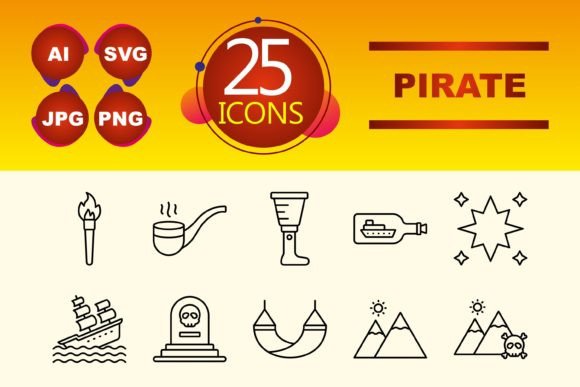
In the vast ocean of digital design, where visual communication reigns supreme, a unique and playful set of symbols has carved its niche: Pirate icons. These aren't just whimsical illustrations of swashbucklers and treasure chests; they represent a specialized asset pack, a curated collection of vector graphics centered around the theme of piracy. This article delves into the purpose, significance, and practical application of such icon sets, specifically focusing on a set that offers 10 Line-style icons in versatile file formats like AI, JPG, PNG, and SVG. We'll navigate how these tiny graphical treasures fit into contemporary design projects, from mobile apps to business presentations, clarifying their role beyond mere decoration.
The Anatomy of a Pirate Icon Set
Let's start from the ground up. An icon set, like the Pirate collection described, is a cohesive group of graphical symbols designed to convey specific concepts, actions, or objects visually. The "Pirate" theme dictates the subject matter, meaning each icon—likely including a pirate hat, a ship, a compass, a treasure map, a parrot, an anchor, a sword, a hook, a chest, and a skull & crossbones—instantly communicates ideas related to adventure, exploration, history, risk, or treasure.
The designation "Line Icon" style is crucial. Unlike filled or solid glyph icons, line icons are created using strokes or outlines. They are typically clean, minimalist, and often monochromatic, focusing on the essential shape and contour of the object. This style offers a modern, uncluttered look that integrates seamlessly into interfaces without overwhelming them with detail or color.
File Formats: The Key to Versatility
The included file types—AI, JPG, PNG, and SVG—are not arbitrary; they are the engine of practical relevance. Each format serves a distinct purpose:
- AI: The Adobe Illustrator source file. This is the editable master, allowing designers to modify colors, stroke weights, or shapes without loss of quality, perfect for customization.
- SVG: Scalable Vector Graphics. This web-friendly format is resolution-independent, meaning icons scale perfectly to any size without pixelation, making them ideal for responsive websites and apps.
- PNG & JPG: Raster image formats. PNG offers transparency (useful for overlays), while JPG is a standard compressed format. These are handy for quick placement in documents, basic web use, or environments where vector support is limited.
This multi-format approach ensures the icon set is truly "ready-to-use" across virtually any digital canvas.
The Purpose and Significance in Modern Design
So, why would a designer seek out a themed icon set like this? The significance lies in consistency, speed, and thematic reinforcement. In professional design, consistency in visual language is paramount. Using a pre-made set guarantees that all pirate-themed symbols share the same line weight, stylistic approach, and level of detail, creating a harmonious look instantly. This saves countless hours compared to designing each icon from scratch.
More importantly, icons are fundamental tools for user interface (UI) design and information architecture. They guide users, denote functions, and break up text-heavy content. A pirate-themed set might seem niche, but its purpose extends into various sectors of modern life and work.
Fitting into Modern Projects: Beyond the Obvious
A common assumption is that such icons are only for children's games or Halloween apps. This is a misunderstanding. Their practical relevance is broader:
- Education & e-Learning: Used in interactive modules about maritime history, geography, or adventure literature. A treasure map icon could mark a quiz, or a ship icon could denote a "voyage" to the next chapter.
- Business & Marketing: For companies in travel, adventure tourism, or gaming, these icons can add thematic flair to presentations, infographics about "treasure hunts" for market opportunities, or website sections highlighting "exploratory" services.
- Mobile Apps & Websites: Not just for games. A budgeting app with a "pirate" mode for aggressive saving (treasure chest), a navigation app with adventurous themes, or a storytelling platform—icons enhance UX with recognizable metaphors.
- Creativity & Personal Projects: Bloggers, content creators, or educators making materials about pirates, exploration, or team-building "scavenger hunts" can use these icons to visually enrich their content quickly.
The key is that the theme supports a metaphor. "Pirate" can symbolize discovery, risk, adventure, or hidden value, making these icons applicable in many metaphorical contexts.
Building a Broader Understanding: Icons as Visual Language
To fully appreciate this set, one must see it as part of the larger ecosystem of visual design assets. Icons are a fundamental component of the visual language we use daily on our devices and in media. They are, in essence, a form of universal shorthand. A well-designed icon set, even a themed one, follows principles of clarity, scalability, and cultural recognition.
The Line Icon style chosen here is particularly relevant in today's design trends, which often favor minimalism and clarity over ornate detail. This style ensures the icons remain legible even at very small sizes, such as in mobile app navigation bars or as bullet points in a dense infographic.
Examples in Context
Imagine a website template for a pirate museum. The navigation could use a ship icon for the "Exhibits" page, a compass icon for "Visit Us" (directions), and a parrot icon for "Events" (something lively). Each icon reinforces the theme intuitively.
In a corporate team-building presentation about "unlocking innovation," a slide titled "Finding Your Treasure" could be accented with the treasure chest icon, making the concept memorable and visually engaging.
These examples show how the icons function not as standalone art, but as integrated elements that support communication and user experience.
Conclusion: A Valuable Asset for Diverse Voyages
A specialized Pirate icon set, offering 10 clean line icons in multiple production-ready formats, is more than a novelty. It is a practical design resource that embodies efficiency, consistency, and thematic strength. By understanding its composition (line style, versatile files), its purpose (visual shorthand and thematic reinforcement), and its wide applicability (from education to business to personal creativity), designers and content creators can effectively harness it to enhance their projects.
Whether you're designing an educational app, crafting a compelling business infographic, building a themed website, or simply adding visual interest to a presentation, such a set provides a ready-made visual vocabulary. It allows you to sail quickly past the tedious work of asset creation, focusing instead on the broader narrative and user experience of your project—a true treasure for any modern design voyage.