The Vibrant World of Street Market Icon Sets: Digital Symbols for Everyday Commerce
In the bustling digital landscape, where visual communication is paramount, the ability to convey ideas quickly and elegantly is essential. Icon sets serve as the visual shorthand of our apps, websites, and presentations. Among these, themes rooted in everyday life, like a Street Market collection, offer a unique and universally relatable vocabulary. This article explores the purpose, significance, and practical application of a specialized Street Market icon set, delving into how these simple lines and shapes can enrich digital projects from mobile apps to business infographics.
Understanding Icon Sets: The Building Blocks of Visual Design
Before focusing on the street market theme, it's helpful to grasp the foundational role of icons in digital design. Icons are simplified graphical representations of objects, actions, or ideas. They transcend language barriers, guiding users intuitively through interfaces and enhancing the aesthetic cohesion of any project. A well-designed icon set provides a consistent visual language, ensuring that all symbols share a common style, such as line weight, detail level, and artistic perspective. This consistency is key to professional and user-friendly design.
The Specific Appeal of a Street Market Theme
A Street Market icon set taps into a rich, familiar imagery. Street markets are global phenomena—spaces of commerce, community, and culture. Icons depicting a market stall, a shopping basket, a coin for payment, or a fresh produce item carry immediate connotations of local trade, freshness, direct transaction, and vibrant public life. This theme is not just decorative; it evokes specific feelings and contexts, making it incredibly versatile for projects related to local business, e-commerce, food services, community apps, or economic presentations.
Consider a mobile app for a farm-to-table delivery service. Using a line icon of a carrot or a market umbrella in its interface instantly communicates its core values of direct sourcing and fresh goods, without needing lengthy textual explanations. The theme bridges the gap between traditional commerce and modern technology.
Deep Dive: Features and File Types of a Typical Set
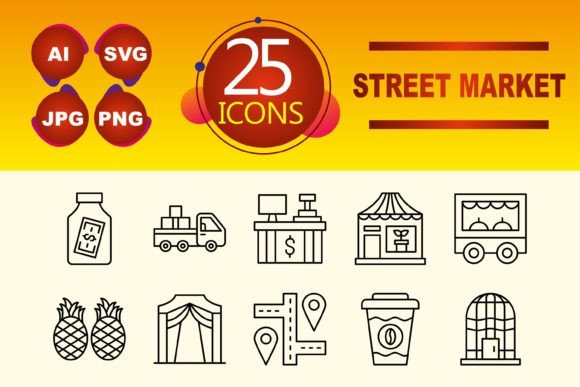
As described, a focused set might include 10 icons covering core market concepts. Common examples could be: a vendor stall, a weighing scale, a money bag or coin, a shopping bag, a cart, common produce (like an apple or fish), a price tag, a customer, and perhaps a market banner or arch. The Line Icon style is particularly popular for its clarity and modernity. Line icons use clean, continuous strokes to outline shapes, often with minimal fills. They are sleek, scalable, and integrate seamlessly into contemporary minimalist designs.
The practical value of such a set is amplified by the file types included. Professional sets typically provide:
- AI (Adobe Illustrator): The editable vector source file, allowing designers to modify colors, scales, or strokes without quality loss.
- JPG: A raster format useful for quick placements in documents or non-scalable contexts.
- PNG: Especially with transparency, perfect for web and app design where icons need to overlay various backgrounds.
- SVG (Scalable Vector Graphics): The modern standard for web development, scalable to any size with perfect clarity, and often animatable.
This multi-format approach ensures the icons are ready for any scenario, from a high-resolution presentation slide (using PNG) to an interactive website feature (using SVG).
Practical Relevance Across Digital Arenas
The utility of a themed icon set like this extends far beyond mere decoration. Let's explore its application across several key domains.
Mobile Applications & User Interfaces
In app design, screen space is precious and user attention is fleeting. Icons serve as navigational anchors. A community-focused app for local artisans might use a market stall icon for the "vendors" section and a coin icon for the "payment" method. This creates an instant, intuitive connection for the user. The line style ensures the icons remain crisp and legible even on small mobile screens.
Website Templates and Business Platforms
For a website promoting a local farmers' market or a craft business, these icons can be used in hero sections, feature lists, or footer areas. They visually break up text content and reinforce the site's thematic message. An SVG icon of a shopping basket next to a "Order Now" button is more engaging than plain text.
Presentations and Infographics
In business or educational presentations about local economies, retail trends, or cultural studies, these icons become powerful visual data points. An infographic on the growth of street markets could use the scale icon to represent "fair trade" and the produce icon to symbolize "organic growth." Visual storytelling with familiar symbols makes complex information more digestible.
Creativity and Template Design
For graphic designers and template creators, a coherent set like this is a foundational asset. It allows for rapid prototyping and design consistency. Whether creating a brochure template for a food festival or a UI kit for a shopping app, having pre-made, style-matched icons saves immense time and ensures a polished final product.
Clarifying Common Misunderstandings
Two assumptions often arise around such niche icon sets. First, that they are only for projects directly about street markets. This is too narrow. Their symbolism is transferable. A coin icon can represent any transaction; a stall icon can represent any small business or point of sale. Second, that line icons are "basic" or lack impact. Conversely, their simplicity is their strength—they are clean, modern, and avoid visual clutter, which is crucial in functional design where clarity is the priority over ornate decoration.
Building a Broader Understanding: Icons as Cultural Bridges
Ultimately, a Street Market icon set exemplifies how digital design tools can reflect and honor real-world cultures and practices. It connects the digital experience to tangible, human-centric activities. In an age where technology can feel abstract, using icons rooted in communal, physical spaces like a market adds warmth and relatability to digital products. It's a reminder that good design speaks not only to functionality but also to context and emotion.
For beginners, starting with a well-defined, thematic set like this is an excellent way to learn icon integration without the overwhelm of a massive, generic library. For experienced designers, it offers a ready-made, stylistically pure component to elevate projects with a specific narrative tone. By understanding the features—the 10 line-style icons in versatile AI, JPG, PNG, and SVG formats—and recognizing their wide applicability, anyone can harness these small symbols to create more engaging, intuitive, and visually coherent digital experiences across mobile apps, websites, presentations, and beyond.
In your next project that touches on commerce, community, locality, or freshness, consider the silent power of a simple line drawing of a market stall or a basket. These icons are more than just pictures; they are compact carriers of meaning, ready to bring a touch of the vibrant, real-world market into your digital canvas.