Understanding Cloud Computing Icons: The Universal Language of Digital Design
In the vast landscape of digital communication, icons serve as a silent, yet powerful, universal language. They guide us through apps, simplify complex ideas on websites, and add visual clarity to reports and presentations. Among the myriad icon families available, Cloud Computing Icons have emerged as a particularly essential set. Designed with a focus on simple and clean aesthetics, these icons are more than just decorative elements; they are functional tools that bridge the gap between abstract technological concepts and user understanding.
The Core Purpose of Simple Icon Design
Why does simplicity in icon design matter so much? The answer lies in usability and communication efficiency. A clean, well-designed icon conveys its message instantly, without requiring the user to decipher complex visual clutter. This is crucial in fast-paced environments like mobile apps or dashboard interfaces, where user attention is limited. For topics like cloud computing—which encompasses ideas like data storage, servers, networks, and security—using intuitive icons can demystify the technology for beginners. An icon depicting a "cloud" with an upward arrow immediately suggests "upload to the cloud," a concept far more accessible than the technical term "data migration to a remote server." This approachable design philosophy makes these icons perfect not just for tech experts, but for educators, marketers, and content creators who need to explain these concepts to a general audience.
From Digital Screens to Print Media: The Versatile Application
The true power of a high-quality vector icon set lies in its versatility. As specified, icons with a simple and clean design are adaptable across a staggering array of mediums. Their utility extends far beyond the pixel-based world:
- Digital Platforms: They are fundamental to website UI/UX, mobile app buttons, and social media graphics, enhancing navigation and brand consistency.
- Print and Physical Media: The same icons can be seamlessly used in corporate brochures, flyers, books, educational infographics, banners, and posters without loss of quality.
- Business and Education: In presentations, training manuals, or white papers, these icons help visualize processes like SaaS (Software as a Service), IaaS (Infrastructure as a Service), or data flow, making complex information digestible.
This cross-medium compatibility ensures that a single, coherent visual language can be maintained across an entire project or campaign, from a digital ad to a printed conference handout.
The Significance of Fully Customizable Vector Files
A key feature that transforms a good icon set into a indispensable asset is full customization. The mention of editing in vector software like Adobe Illustrator or CorelDRAW is not a minor detail; it is the cornerstone of practical relevance. Unlike a static PNG image, a vector file (such as .AI or .EPS) defines the icon using mathematical paths and points. This means the design is resolution-independent—it can be resized to any dimension, from a tiny app button to a billboard-sized poster, without ever becoming blurry or pixelated.
Moreover, customization empowers the designer or content creator to adapt the icons to specific needs:
- Resizing: Instantly scale icons for different layout requirements.
- Color Change: Match the icon color to your brand palette or project theme effortlessly.
- Editing Stroke Weight: Adjust the line thickness to create a lighter or more bold visual impact, enhancing hierarchy and readability.
This level of control ensures the icons never feel "off-the-shelf" but can be tailored to integrate perfectly with your unique design vision.
Clarifying Common Misunderstandings About Icon Files
There are often assumptions about what an icon purchase includes. It's important to clarify that, as noted, Preview Mockups are Not Included. The product focuses on the core, reusable assets. The included file formats each serve a distinct, critical purpose:
- Source File (.AI): The native Adobe Illustrator file, allowing deep editing of all original vector elements.
- EPS Version 10: A universal vector format compatible with many professional design and layout programs.
- SVG File: The modern standard for web development, scalable and manipulable with code.
- PNG Transparency: Ready-to-use raster images with transparent backgrounds for quick placement in any digital composition.
- Readme.txt: Provides essential instructions for use and licensing, a simple but crucial component.
Understanding these formats helps users select the right file for their specific task—using SVG for a web developer, EPS for a print designer, and PNG for a social media manager.
How Cloud Computing Ions Fit Into Modern Creativity and Work
In today's interconnected world, cloud computing is no longer a niche IT topic; it's a part of daily business and personal life. Consequently, visuals representing it are increasingly necessary. For a small business owner creating a website to explain their online services, these icons provide instant credibility and clarity. For a teacher developing an infographic about internet safety and data storage for students, simple icons make the lesson engaging and understandable. For a tech blogger, they serve as clear, professional graphics to accompany articles.
The Easy Drag and Drop nature of the included files, particularly the PNGs, speaks directly to the need for efficiency in modern workflows. Not everyone is a seasoned graphic designer. Many content creators, project managers, or educators work in tools like Canva, PowerPoint, or basic web editors. Having pre-made, transparent PNG files allows them to incorporate professional-grade visuals into their work with minimal technical friction, significantly elevating the quality of their output.
Building a Broader Understanding: Icons as Part of a Visual Ecosystem
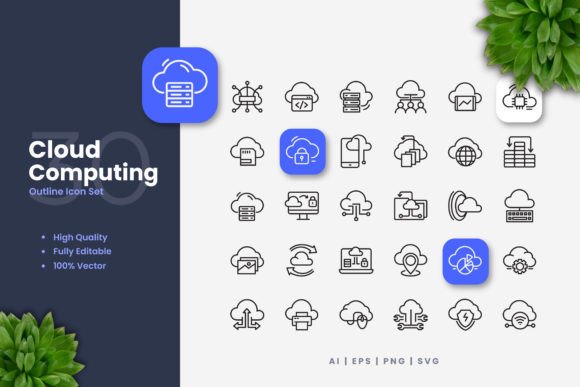
Viewing these Cloud Computing Icons not as isolated graphics, but as part of a broader visual communication strategy, is crucial. They are lexical units in the visual language of your project. When combined with consistent color, typography, and layout, they build a cohesive narrative that guides the audience. Their high-quality design ensures they don't detract from that narrative but reinforce it. By representing concepts like cybersecurity (with shield icons), collaboration (with shared file icons), or innovation (with cloud-and-gear icons), they help audiences build a mental model of how cloud technology functions and benefits them in real-life scenarios—from backing up smartphone photos to collaborating on a global team document.
Ultimately, a set of simple, clean, and fully customizable cloud computing icons is more than a design asset. It is a toolkit for effective communication. It empowers individuals and businesses to translate a complex, invisible technological infrastructure into clear, accessible, and engaging visual stories. Whether the final medium is a screen, a page, or a banner, these icons help demystify the cloud, making the digital world a little more understandable for everyone.