The Man Farmer Kawaii Doodle Line Art Collection: A Workflow Asset for Modern Creators
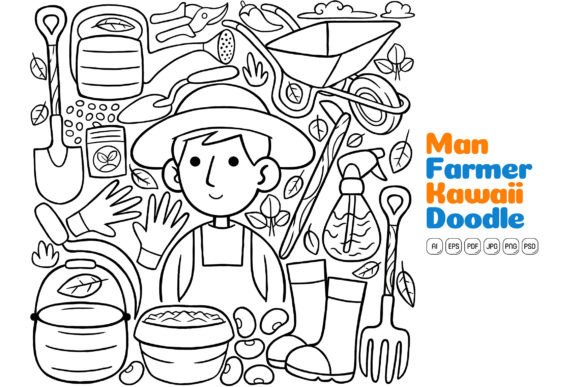
In the fast-paced world of digital creation, having versatile, editable assets is not just a convenience; it's a cornerstone of efficient workflow. The Man Farmer Kawaii Doodle Line Art collection exemplifies this principle. It is a set of 100 vector illustrations crafted in a super cute, hand-drawn doodle art style. Beyond its immediate aesthetic appeal, this collection functions as a practical toolkit designed for integration into a wide array of professional and personal projects. Its value lies not merely in the final artwork but in its role within a broader creative and communicative process, enabling speed, consistency, and customization.
Understanding the Asset: More Than Just Pictures
The collection is fundamentally a set of components. Each illustration—from the central farmer character to accompanying agricultural elements—is delivered as a vector file (EPS) compatible with Adobe Illustrator, alongside high-resolution JPGs. The flat design style and line art foundation mean that every shape is distinct and editable. This technical aspect is crucial for workflow integration. You are not receiving static, finished images; you are receiving the building blocks to create countless variations. The ability to resize infinitely and change the color of each individual shape transforms these doodles from a product into a process tool.
Where It Fits in Your Creative and Business Process
The utility of the Man Farmer Kawaii Doodle Line Art collection spans the entire lifecycle of a project. For a marketer planning a campaign for a local farm or organic product, these illustrations can be used early in the concept phase to visualize branding and social media themes. A blogger or educator can integrate them into article or lesson plan layouts during the content creation phase to add visual breaks and thematic reinforcement. For a small business owner designing printing materials or website banners, the collection serves during the execution and production phase, providing ready-to-customize graphics that eliminate the need for custom illustration commissions.
Its interaction with other tools and resources is seamless. Because the files are vector-based, they can be imported directly into design software like Adobe Illustrator, where they coexist with your other brand assets, typography, and layout elements. For users who also work in platforms like Canva or Affinity Designer, the high-resolution JPG files provide a quality fallback. This compatibility ensures the collection doesn't require a specialized workflow; it fits into the one you already have.
Practical Implementation: Integrating Kawaii Doodles into Your Workflow
Effective use of such an asset requires a slight shift in perspective—from finding a perfect final image to assembling the perfect custom illustration. Start by assessing your project's needs. Do you require a single hero image for a landing page, or a series of cohesive icons for an infographic? The Man Farmer Kawaii Doodle Line Art collection supports both.
Workflow Example 1: Building a Social Media Campaign
Imagine you are tasked with creating a month-long social media series for a community garden. Your process might begin by selecting a core set of 10-15 relevant doodles from the 100 available—the farmer, vegetables, tools, sun, raincloud. Place these EPS files into a dedicated project folder in Illustrator. As you plan each post, you can open the base file, change colors to match your brand palette (e.g., making the farmer's hat your brand blue), resize elements to create emphasis, and combine different items to create unique scenes for each day's message. This approach guarantees visual consistency across the campaign while allowing for daily variation, all without starting from scratch each time.
Workflow Example 2: Enhancing Educational or Publishing Materials
For an educator creating a worksheet or a publisher designing a book interior, the high resolution and easy to edit nature of these doodles aids in rapid prototyping. You can quickly place JPGs into a document layout to assess visual flow. Later, for final print-quality files, use the vector versions to ensure crisp lines at any size and adjust colors to be printer-friendly. This separation of draft use and final production use streamlines the quality control process, as you know the base asset will not degrade.
Key Factors for Long-Term Asset Utility
Investing in a collection like this is about long-term workflow efficiency. Several factors ensure its enduring value. Preparation is minimal: the files are organized and ready to use. Usability is high due to the simple, separated shapes in the vector format, even for those with intermediate design skills. For organization, it is wise to create a master library file in your design software where you store your customized versions of the doodles—your brand's specific color schemes, your most-used compositions. This builds a derivative asset library that saves even more time on future projects.
Efficiency is perhaps the most significant gain. The time saved by not searching for disparate, royalty-free images or commissioning custom doodle art for every small project compounds. It allows creators to focus on message and layout rather than asset creation. Furthermore, the ability to combine different elements and create your own illustrations as stated in the collection's description encourages creative problem-solving. A farmer doodle can be placed next to a chart doodle from another set to create an infographic about farming statistics, fostering interdisciplinary use.
Ensuring Consistency Across Platforms
For professionals managing a brand's presence across infographics, social media, printing material, website, and landing pages, visual consistency is paramount. Using the same core set of kawaii doodle line art across all these mediums, customized to the correct sizes and formats (vector for print, optimized JPG for web), creates a cohesive visual identity. The collection’s size of 6500 x 6500 pixels provides a large enough canvas that you can scale down for a web banner or scale up for a large poster without ever hitting a resolution limit.
Adapting the Collection to Your Unique Needs
The true test of a workflow asset is its adaptability. The Man Farmer Kawaii Doodle Line Art is not confined to agricultural themes. The cute, friendly aesthetic can be repurposed to convey concepts of growth, care, sustainability, manual work, or community in entirely different contexts—a tech startup's blog about "cultivating" customer relationships, a life coach's materials on personal "growth." By changing colors to suit a new mood and combining elements with other graphics, the collection's utility expands beyond its nominal subject.
In practice, integrating it smoothly means treating it as part of your digital toolkit. When a new project kicks off, alongside your checklist for copy, strategy, and platform, include a step to review your asset libraries. See if this doodle collection, or your customized versions of it, can serve the visual need. This habitual integration turns a purchased resource into an active component of your creative process, reducing friction and elevating the quality of your output with a unique, engaging visual style.
Ultimately, collections like this bridge the gap between having a professional visual standard and maintaining project agility. They empower the solo freelancer, the busy marketer, and the ambitious small business owner to produce work that looks deliberately designed, without the time investment of deliberate design from scratch for every task. By focusing on the process-oriented use of these assets—how they are edited, combined, and implemented across projects—creators unlock not just 100 illustrations, but a sustainable method for enhancing their visual communication.