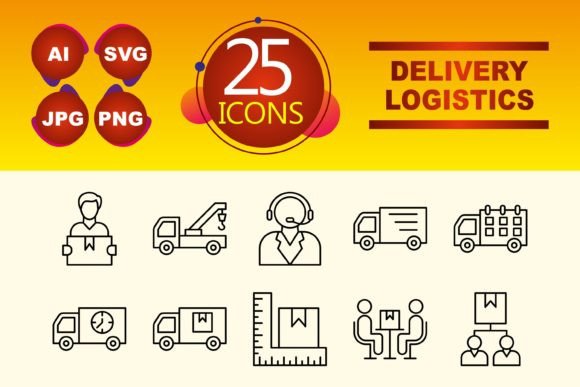
Understanding Delivery Logistics and Icon Usage
Delivery Logistics refers to the comprehensive process of planning, executing, and managing the efficient transportation and distribution of goods from a source to a final destination. This encompasses a wide array of activities, including order fulfillment, warehousing, inventory management, route optimization, and last-mile delivery. In the digital age, representing these complex processes visually is crucial for communication, design, and user interface clarity.
Core Concepts and Visual Representation
At its heart, Delivery Logistics is about movement, coordination, and tracking. Icons serve as a universal language to symbolize these actions within apps, websites, and presentations. A typical set focusing on Delivery Logistics might include symbols for vehicles like trucks or vans, packages, maps for routing, warehouses, delivery confirmation, and tracking statuses. These icons allow designers and developers to create intuitive interfaces where users can instantly grasp functionality related to shipping, order status, or fleet management without relying solely on text.
The availability of such icons in multiple file formats, including AI for scalable vector design work, JPG for standard imagery, PNG for transparency, and SVG for web-based scalable graphics, ensures they are adaptable to various technical requirements. The Line Icon style, characterized by clean, outlined drawings, offers a modern and minimalist aesthetic that fits contemporary design trends across platforms.
Key Reasons for Interest in Delivery Logistics Icons
Individuals and teams might seek out a dedicated Delivery Logistics icon set for several practical reasons. Primarily, they are a resource for enhancing user experience in digital products. For instance, a mobile app developer building a courier service application needs clear, recognizable icons to represent "active deliveries," "package pickup," or "route planning" within the app's navigation and status screens. Similarly, a website template designer creating an e-commerce site requires visual elements to illustrate shipping options or order tracking pages.
Beyond digital interfaces, these icons are valuable in creating presentations for logistics company pitches, internal process training, or investor reports, where visual aids improve comprehension. They also serve as foundational assets for infographics that explain supply chain steps or delivery performance metrics, making complex data more accessible.
Benefits, Tradeoffs, and Considerations
The primary benefit of using a curated set like this is consistency and speed. Having ten coordinated icons in a unified Line style means a designer can rapidly prototype or build a section of a project without searching for disparate images or creating custom drawings from scratch. This saves significant time and ensures a cohesive visual language throughout the project. The inclusion of SVG and AI files specifically supports scalability and professional editing, allowing icons to be resized or slightly modified without loss of quality.
However, there are tradeoffs to consider. A set with only ten icons, while covering fundamental concepts, might not encompass every niche scenario within Delivery Logistics. A project involving specialized logistics, like refrigerated transport or international customs documentation, might require additional, more specific symbols. In such cases, this core set would need to be supplemented. Furthermore, the Line Icon style is a specific aesthetic choice. While modern and clean, it may not align with a brand or project that requires a more filled, solid, or illustrative icon style. Evaluating whether the visual tone matches the overall design intent is essential.
Expectations should be set around utility rather than exhaustive coverage. This type of set is a strong foundational tool, not a complete solution for every possible logistics visualization need. The practical expectation is that it provides a quality starting point for the most common visual representations in the domain.
Situations Where Delivery Logistics Icons Are a Strong Fit
This icon set is a particularly strong fit for projects that need to communicate standard Delivery Logistics concepts quickly and elegantly. It aligns well with the development of user-facing applications where clarity is paramount, such as customer tracking portals for e-commerce, driver management apps for logistics firms, or internal dashboards for warehouse operations. Its multi-format availability makes it ideal for hybrid projects, like a website that also uses assets in a printed presentation.
For designers creating templates—whether for websites, mobile apps, or presentation decks—having a pre-made, stylistically consistent set of icons is a major advantage. It allows the template to offer more value and functionality to its end-users, who can then implement these visuals without additional graphic design work. The set is also a good fit for educational or explanatory materials, like tutorial infographics or process flowcharts aimed at teaching audiences about basic delivery and supply chain operations.
When to Consider Alternatives
Alternatives should be explored when project requirements diverge from the offerings of this specific set. If a project demands a much larger library of icons, perhaps covering hundreds of nuanced logistics and transportation scenarios, a more extensive commercial icon library or a custom icon design project would be a better consideration. Similarly, if the required visual style is not "line" based—for instance, needing flat, filled, 3D, or highly detailed realistic icons—then searching for a set matching that specific aesthetic is necessary.
Another scenario where alternatives are worth considering is when deep integration with a specific design framework is needed. Some developers might prefer icon sets that are bundled as web font icons or are part of a larger component library for a coding framework like React or Vue. While SVG files from this set can be integrated, the process might require more manual effort compared to a purpose-built icon font.
Practical Decision-Making Insights
To determine if a Delivery Logistics icon set aligns with your goals, start by auditing your project's actual visual needs. List the specific logistics concepts you need to represent: do they match the likely contents of this set (e.g., vehicle, package, location, warehouse)? Next, review your design guidelines: does the Line Icon style complement your existing color palette, typography, and overall visual identity? Finally, assess your technical requirements: do your developers or design tools work best with SVG files for the web, or do you primarily need AI files for high-fidelity print design? The set's format offering should directly support your workflow.
Consider also the stage of your project. For early-stage prototyping and proof-of-concept work, a concise, versatile set like this can be immensely helpful to convey ideas quickly. For a final, branded product launch, you must ensure the icons feel unique and aligned with your brand, which might still use this set as a base for customization given the editable vector AI and SVG formats.
Aligning with Audience Goals and Needs
For audiences researching or selecting design assets, the decision ultimately hinges on specificity versus generality. If your goal is to find a ready-made solution for common Delivery Logistics visuals that speeds up design and development across multiple media types (apps, websites, presentations), this set is likely well-aligned. It meets a practical need for efficiency and consistency.
If your need is to build a uniquely branded, comprehensive visual system for a large-scale logistics platform, or if your project operates in a highly specialized sub-field of logistics not covered by generic icons, then this set may only serve as a partial solution or a starting point. Your needs would align more with a bespoke design approach or a much larger, more specialized icon collection. By objectively evaluating the scope of your project, your aesthetic constraints, and your technical format requirements, you can make a clear determination on the utility of a foundational Delivery Logistics icon set for your specific objectives.